Bancobi Support Group at eKutsimuleni, a community farming initiative birthed by Nazarene Compassionate Ministries Eswatini (NCM-E) under its Task Force Project, has received a significant boost in farming tools, infrastructure, and inputs to strengthen production and build resilience against climate shocks.
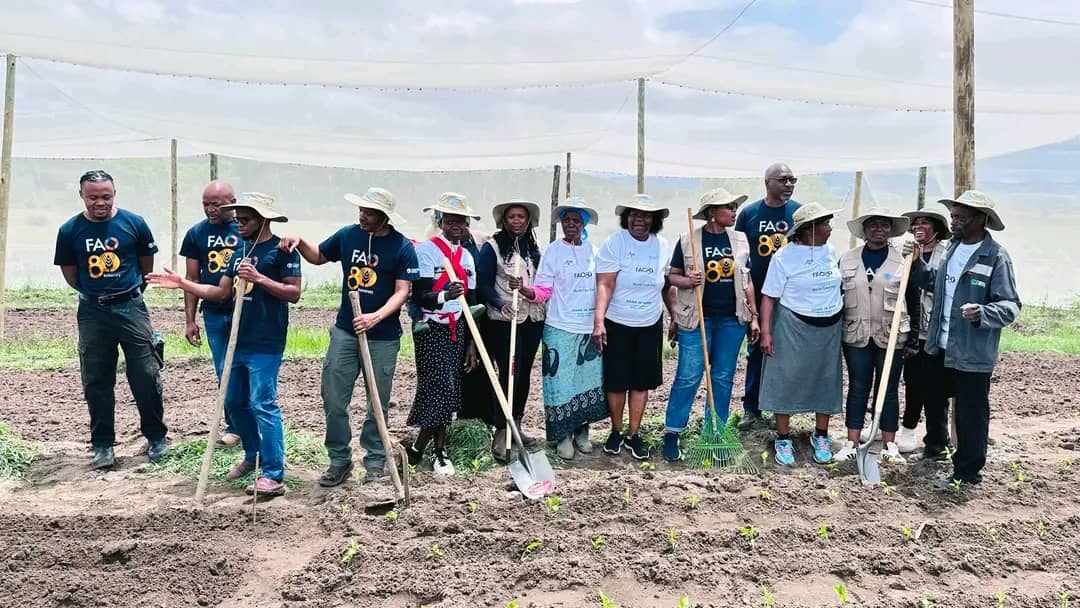
On the day of the visit, NCM-E handed over essential farming tools — including hoes, spades, and rakes — to enable the group to scale up its crop production and improve day-to-day farm operations. This gesture was part of an ongoing commitment by NCM-E to ensure that community-based groups it establishes are not only formed, but equipped to thrive.
This local support coincided with a broader intervention from the Food and Agriculture Organization (FAO), working in collaboration with the Ministry of Agriculture and NAMBoard, as part of FAO’s 80th Anniversary and World Food Day activities. The support package included a 2,000 m² shade net, irrigation equipment, and a variety of high-quality seedlings — all aimed at boosting productivity, reducing post-harvest losses, and ensuring a consistent supply of fresh vegetables to the local market.
A Group Built from Grassroots
Bancobi is made up of 15 smallholder vegetable farmers who have been producing for local markets for several years. The group was originally mobilised and supported by NCM-E to promote livelihoods, food security, and self-reliance among vulnerable households in the area. Over time, Bancobi has grown into a model of what faith-based, community-rooted development can look like when it is backed by the right partnerships.
“This support means everything to us,” said Margaret Mhlanga, Chairperson of the group. “The shade nets and irrigation system will help us protect our crops from pests and extreme weather, allowing us to maintain quality and expand our market base. It will also help us support our families and send our children to school.”
Partnership in Action
FAO Senior Programmes Officer Sibusiso Mondlane emphasised that Bancobi is not a once-off beneficiary, but a long-term partner in FAO’s effort to empower rural farmers.
“We have walked with Bancobi for many years and remain committed to supporting them with inputs, training, and marketing opportunities,” he said, noting that the group’s progress aligns with FAO’s drive to promote sustainable food systems in Eswatini. The Ministry of Agriculture, represented by Senior Extension Officer Mazwi Dlamini, commended the group’s consistency and NCM-E’s role in initiating and sustaining such community structures.
“Farmers like Bancobi are the backbone of our rural economy. Their resilience and innovation inspire others across the country,” he said. NAMBoard’s contribution of seedlings on the day further demonstrated how coordinated support — from government, development partners, and faith-based organisations — can accelerate smallholder success.
NCM-E’s Role: From Formation to Sustainability
For NCM-E, the day was not just about donating tools; it was about affirming a journey. Bancobi was started by NCM-E to give community members a practical pathway to livelihoods, and the organisation continues to walk alongside them to ensure the group does not stall due to lack of equipment or technical support.
By providing basic tools, NCM-E has helped close a crucial gap: farmers now have the infrastructure (shade net and irrigation from FAO), the planting material (from FAO and NAMBoard), technical backstopping (from the Ministry of Agriculture), and the day-to-day hand tools needed to actually work the land.
This is in line with NCM-E’s broader livelihood and food security agenda, to move vulnerable households from dependency to productivity.
Marking FAO’s 80 Years with Action
As part of its 80th Anniversary commemorations, FAO joined the farmers in planting green pepper seedlings — a symbolic and practical act that reinforced the message of “growing hope, together.” The activity also aligned with World Food Day’s focus on building resilient food systems and supporting smallholder farmers who are on the frontlines of climate change.
Building a Climate-Smart Future
The combined investments shade netting, irrigation, seedlings, tools, and ongoing extension — are expected to:
- Improve year-round production through protected cultivation
- Reduce losses caused by heat, pests, and erratic rainfall
- Strengthen the group’s ability to meet market demand consistently
- Enhance household incomes and food security for member families
- Demonstrate how partnerships can localize national food security goals
For the Bancobi Support Group, this support is more than material assistance, it is a lifeline. It signals confidence in their work, opens doors to better markets, and, importantly, shows that a group started by NCM-E can grow into a model of agricultural self-reliance when faith-based action is matched with government and development support.
About NCM-E
Nazarene Compassionate Ministries Eswatini works to restore dignity and strengthen community resilience through humanitarian response, livelihoods support, child development, and partnerships with government and development agencies. The Bancobi Support Group is one of several community initiatives established under NCM-E’s Task Force Project to empower households through agriculture.